
3M vs Avery Dennison Wrap Film: Fleet Buyer's Guide
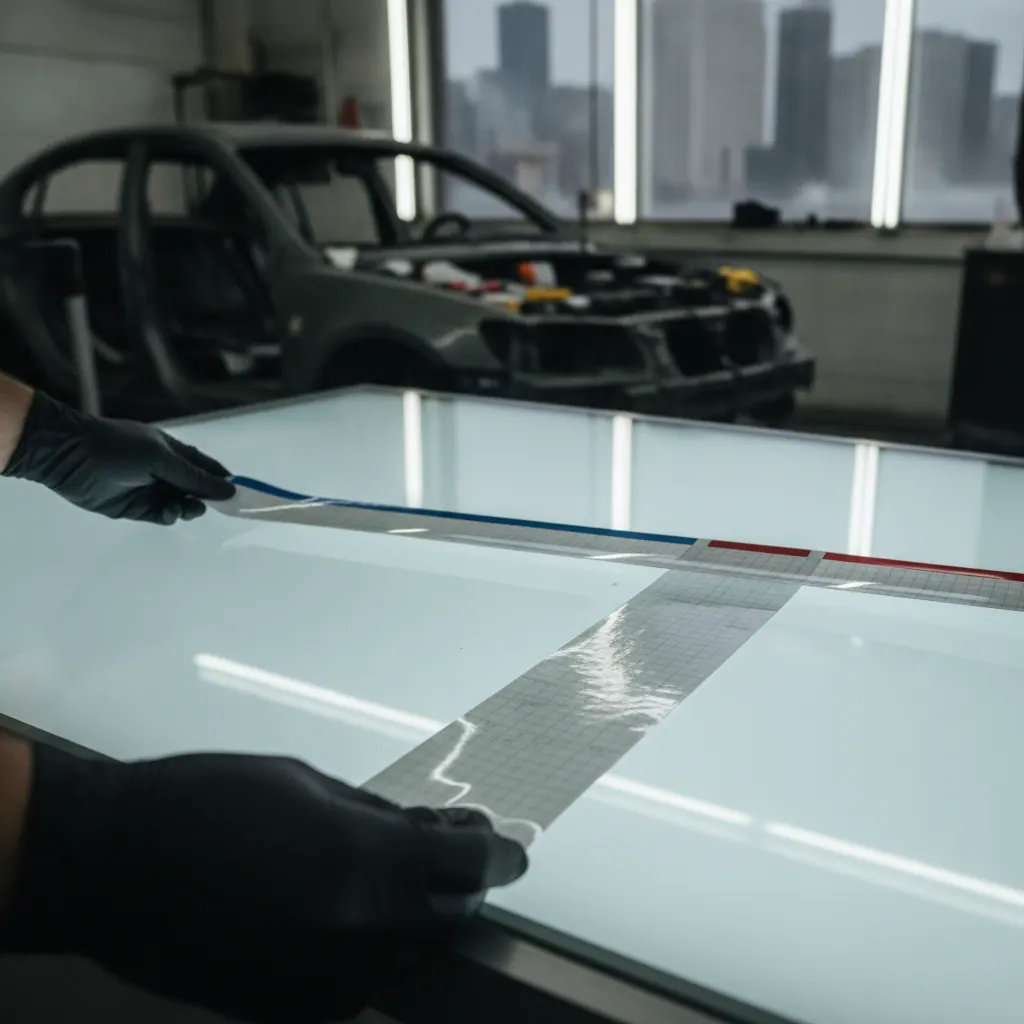
For fleet buyers choosing between 3M and Avery Dennison wrap films, both are cast vinyl and both perform well, but each has real strengths and real trade-offs depending on vehicle type, fleet size, and exposure conditions. Chicago Fleet Wraps has installed both materials across 19,400+ vehicles since 2001, including 600+ Rivian EV installs, with zero verified paint-damage claims. This guide gives you the unfiltered field comparison so you can buy with confidence.
For fleet buyers choosing between 3M and Avery Dennison wrap films, both are cast vinyl and both perform well, but each has real strengths and real trade-offs depending on vehicle type, fleet size, and exposure conditions. Chicago Fleet Wraps has installed both materials across 19,400+ vehicles since 2001, including 600+ Rivian EV installs, with zero verified paint-damage claims. This guide gives you the unfiltered field comparison so you can buy with confidence.
Why Material Choice Matters More Than Brand Loyalty
Most fleet managers arrive at this decision after talking to a sales rep for one brand or the other. That rep will tell you their film is superior. Both are partially right. The real question is which film performs better for your application, your vehicle geometry, your Chicago route exposure, and your replacement cycle.
We see cargo vans running the Kennedy every day, box trucks sitting in Pilsen lots baking under summer sun, and refrigerated units cycling through temperature swings that would destroy a lesser film. The material you spec matters. So does the installer.
One hard rule at Chicago Fleet Wraps: we never use calendered vinyl. Not on a budget job, not as a stopgap. Cast vinyl only, always. If a shop quotes you with calendered film, walk away.
The Films We Actually Use
We stock and install two primary films:
- Avery Dennison MPI 1105 Supercast with UV overlaminate
- 3M IJ180-CV3 and the newer 3M IJ280 with UV overlaminate
Both are true cast films. Both are designed for complex curves and long-term outdoor exposure. Neither shrinks back the way calendered films do. That said, they are not identical products, and the differences matter in the field.
Avery Dennison MPI 1105 Supercast: Honest Assessment
What Avery Does Well
The MPI 1105 Supercast is exceptionally conformable. On vehicles with deep recesses, compound curves, and tight door jamb geometry, this film moves without fighting you. We see this most clearly on European-style cargo vans and on the Rivian delivery vans where panel complexity is high. The film's adhesive releases cleanly during repositioning, which reduces installer error and speeds production time.
Color consistency across large print runs is another genuine strength. If you're wrapping 30 vehicles and need color to match across a 14-month production window, Avery's batch consistency holds up well. For national fleet programs with Chicago as one regional hub, that matters.
The MPI 1105 also performs well on horizontal surfaces facing direct UV. Chicago summers are aggressive. A cargo van roof sitting in a Cicero distribution lot from May through September accumulates serious UV load. The MPI 1105 holds color and gloss better than most films at that price point.
Where Avery Falls Short
Avery's warranty claim process is slower than 3M's. If you need a material defect resolved quickly, the documentation requirements add time. For fleet operators running tight replacement cycles, that lag is a real operational problem.
The MPI 1105 is also slightly less forgiving in extreme cold. Chicago winters are not hypothetical. We install year-round in our climate-controlled bay, so temperature during install is controlled. But post-install, vehicles parked overnight in unheated lots in Rogers Park or Bridgeport during a polar vortex event can stress any film. The MPI 1105 handles it, but the 3M films have a slight edge in cold-weather flexibility.
3M IJ180-CV3 and IJ280: Honest Assessment
What 3M Does Well
The IJ180-CV3 is the most installed commercial wrap film in North America. There is a reason. The adhesive system is mature and well-documented. Removal behavior is predictable. Installers who have worked with it for years can anticipate how it responds to heat, tension, and substrate texture. That predictability reduces rework.
The newer IJ280 improves on the IJ180-CV3 in two specific areas: conformability around tighter radii and improved print vibrancy for digital graphics. If your fleet branding involves fine detail, gradients, or photographic imagery, the IJ280 is worth specifying.
3M's warranty claim process is faster. They have a more developed installer certification infrastructure and a cleaner escalation path when something goes wrong. For fleet managers who need accountability on paper, 3M's documentation is easier to work with.
Cold-weather performance is measurably better. In January installs, even with a heated bay, vehicles move between the controlled environment and the loading dock. The 3M films tolerate that transition better.
Where 3M Falls Short
The IJ180-CV3 is not as conformable as the MPI 1105 on extreme geometry. On a flat-sided cargo van, this is irrelevant. On a vehicle with aggressive body sculpting, or on the Rivian R1T and R1T-based commercial platforms, the Avery film is easier to work with and produces fewer micro-lift points over time.
Print color on the IJ180-CV3 can shift slightly warmer over multi-year UV exposure compared to the MPI 1105. For most commercial applications this is invisible. For brand-critical applications where Pantone matching is contractually specified, it is worth noting in your spec.
Side-by-Side Comparison
- Conformability on complex geometry: Avery MPI 1105 wins
- Cold-weather flexibility: 3M IJ180-CV3 and IJ280 win
- Color batch consistency: Avery MPI 1105 wins for long print runs
- Warranty claim speed: 3M wins
- Print vibrancy for detailed graphics: 3M IJ280 wins
- Removal predictability: 3M IJ180-CV3 wins on aged installs
- UV resistance on horizontal surfaces: Avery MPI 1105 wins
- Installer documentation and certification: 3M wins
No single film dominates every category. Any shop that tells you otherwise is selling, not advising.
Chicago-Specific Factors That Change the Calculation
Chicago is not a neutral testing environment. The city runs your wraps through conditions that accelerate everything. UV load from June through August is intense. Road salt from November through March is corrosive and gets into every seam. The temperature swing from a January polar vortex to an August heat event is 100 degrees or more.
Vehicles running the Eisenhower or the Dan Ryan accumulate grime and particulate that accelerates edge lift if the initial install has any gaps. We use 3M Knifeless Tape on all cuts, which eliminates blade scoring on the vehicle surface and produces cleaner edges that resist lift in these conditions.
For vehicles parked outdoors year-round in neighborhoods like Avondale or South Shore, the UV overlaminate is not optional. We spec it on every job regardless of which base film we use.
Our Numbers From the Field
Chicago Fleet Wraps has wrapped 19,400+ vehicles since founding in 2001. Across that production volume, we have logged zero verified paint-damage claims. We currently serve 2,800+ active fleet accounts. These numbers come from our own job records, not from manufacturer marketing materials. Both 3M and Avery films are represented in that production history.
Fleet Pricing and Discounts
Material choice affects cost, but not as dramatically as volume does. A cargo van full wrap is priced at $4,200. Fleet discounts on single contracts scale as follows:
- 2 to 4 vehicles: 3% discount
- 5 to 9 vehicles: 7% discount
- 10 to 24 vehicles: 11% discount
- 25 or more vehicles: 15% discount
We offer free pickup and delivery across Chicagoland, a 2-year workmanship warranty, and a 5 to 7 year expected wrap lifespan on either film when installed and maintained correctly. Our production lifecycle runs 8 days from material approval to delivery. Quotes are itemized and delivered within 2 hours of your request.
People Also Ask
The Bottom Line for Fleet Buyers
If your fleet runs complex-geometry vehicles, parks in direct sun, or you need tight color matching across a large multi-month production run, specify Avery MPI 1105 Supercast. If your fleet runs flat-sided cargo vans, operates in extreme cold, or you need the fastest possible warranty resolution, specify 3M IJ180-CV3 or IJ280. In many cases we install both films within the same fleet contract based on vehicle type.
What never changes: UV overlaminate on every vehicle, cast vinyl only, 3M Knifeless Tape on all cuts, and installation in our climate-controlled Chicago bay at 4711 N Lamon Ave #7 in Portage Park.
Get Your Itemized Quote in 24 Hours
Call Chicago Fleet Wraps at (312) 597-1286. Tell us your vehicle count, vehicle types, and whether you have brand standards that specify a film. We will tell you which film fits your application, give you a full itemized quote within 24 hours, and schedule free pickup across Chicagoland. No pressure, no upsell, just the information you need to make the right call for your fleet.
Ready for a quote? See Rivian & Amazon DSP Wraps or get an itemized quote in 24 hours.
Frequently Asked Questions
Is 3M or Avery Dennison wrap film better for fleet vehicles?
Neither film is universally better. Avery Dennison MPI 1105 Supercast has stronger conformability on complex vehicle geometry and better UV resistance on horizontal surfaces. 3M IJ180-CV3 and IJ280 have better cold-weather flexibility, faster warranty claim processing, and more predictable removal behavior on aged installs. For Chicago fleet applications, the right choice depends on vehicle type, parking exposure, and your replacement cycle. Both films perform well when installed by an experienced shop using cast vinyl only and proper UV overlaminate.
How long does a fleet wrap last with 3M or Avery film?
With either 3M or Avery Dennison cast film and a UV overlaminate, a properly installed fleet wrap lasts 5 to 7 years under normal commercial use. Chicago conditions, specifically road salt, UV exposure, and temperature extremes, are harder on wraps than moderate climates. Vehicles parked outdoors year-round will trend toward the lower end of that range. Vehicles garaged overnight will trend toward the upper end. Chicago Fleet Wraps backs all installs with a 2-year workmanship warranty regardless of film brand.
What is the difference between cast and calendered vinyl for vehicle wraps?
Cast vinyl is manufactured by spreading liquid vinyl onto a casting sheet and allowing it to cure, which produces a thin, stable film that conforms to curved surfaces and resists shrinkage. Calendered vinyl is made by pressing vinyl through rollers under pressure, which creates a thicker, less stable film that shrinks over time and does not conform well to complex vehicle geometry. For commercial fleet wraps, calendered vinyl is not an appropriate material. It fails faster, lifts at edges, and is more likely to damage paint during removal. Chicago Fleet Wraps uses cast vinyl exclusively on every job.