
Fleet Vehicle Wrap Guide by Class | Chicago Fleet Wraps
Fleet vehicle wraps range from roughly $1,200 for a pickup decal package to $7,500 or more for a full 53-foot trailer, depending on vehicle class and coverage level. Chicago Fleet Wraps has wrapped 19,400-plus vehicles across 2,800-plus active fleet accounts since 2001, which gives us a precise picture of square footage, cost, and impression yield by class. This guide breaks down every major fleet vehicle class so you can build a wrap budget before you ever talk to a vendor.
Fleet vehicle wraps range from roughly $1,200 for a pickup decal package to $7,500 or more for a full 53-foot trailer, depending on vehicle class and coverage level. Chicago Fleet Wraps has wrapped 19,400-plus vehicles across 2,800-plus active fleet accounts since 2001, which gives us a precise picture of square footage, cost, and impression yield by class. This guide breaks down every major fleet vehicle class so you can build a wrap budget before you ever talk to a vendor.
Why Vehicle Class Matters Before You Price a Fleet Wrap
Most buyers price a fleet wrap by asking, "How much for a van?" That question skips four variables that actually drive cost: surface area, panel complexity, coverage level, and material consumption. A Transit cargo van and a 170-inch extended Sprinter are both "vans," but their square footage differs by 40 to 60 square feet. Price them identically and someone gets a bad deal.
At Chicago Fleet Wraps we use cast vinyl only. Every job gets Avery Dennison MPI 1105 Supercast or 3M IJ180-CV3 (or the newer 3M IJ280) with UV overlaminate. We never install calendered vinyl on fleet work. Calendered material shrinks around rivets and corrugated panels, which is exactly the surface profile you find on box trucks and trailers. Cast vinyl conforms. Calendered vinyl peels. That distinction matters more on large-format commercial vehicles than on any other class.
Coverage Levels: Full, Partial, Decal Package
Before diving into class-by-class numbers, align on what "coverage" actually means, because vendors use these terms loosely.
- Full wrap: All painted exterior panels covered. Roof optional but standard on most fleet specs. Maximum brand presence. Highest material and labor cost. Best protection for the paint underneath.
- Partial wrap: Typically 50 to 75 percent of the vehicle. Usually the cargo box sides, rear doors, and lower body. The cab may stay stock or receive only decals. Good middle ground when budget is tight or when the vehicle already carries a base color that matches brand standards.
- Decal package: Individual cut graphics, logo panels, and lettering applied to a clean painted surface. Lowest cost. Lowest impression yield. Appropriate for small pickups or service vehicles where the route covers low-traffic residential streets rather than the Kennedy or the Dan Ryan.
Honest caveat: partial wraps are harder to design well than full wraps. A full wrap gives the designer a clean canvas. A partial wrap has to integrate with whatever paint color the vehicle carries, and if that color drifts from year to year across your fleet, consistency suffers. Factor design complexity into your total cost estimate.
Vehicle Class Breakdown: Square Footage, Pricing, and Pros and Cons
Cargo Vans (Transit, ProMaster, NV, Express)
A standard cargo van runs 200 to 240 square feet of wrappable surface on a full coverage spec. Chicago Fleet Wraps prices a full cargo van wrap at $4,200 at single-unit rate. That number is public on our pricing page and serves as the baseline for fleet discount tiers: 3 percent off for 2 to 4 units, 7 percent for 5 to 9, 11 percent for 10 to 24, and 15 percent for 25 or more units on a single contract.
Pros: Cargo vans have large, flat panel sides. Installation is fast. Wraps pull tight without bubbling. They are the most common fleet class in Chicago, so experienced installers are plentiful and turnaround is predictable.
Cons: The wheel-arch cutouts on ProMasters and the sliding door track on Transits add labor minutes. If your vans sit on Lower Wacker or in Fulton Market loading zones all day, the lower rocker panels take road salt and gravel damage faster than the panel centers. Plan on edge touch-ups at the 24-month mark.
Impressions per dollar: High. The van sides face traffic at eye level. On the Kennedy Expressway inbound during a weekday morning, a wrapped Transit gets seen by thousands of commuters in a single trip.
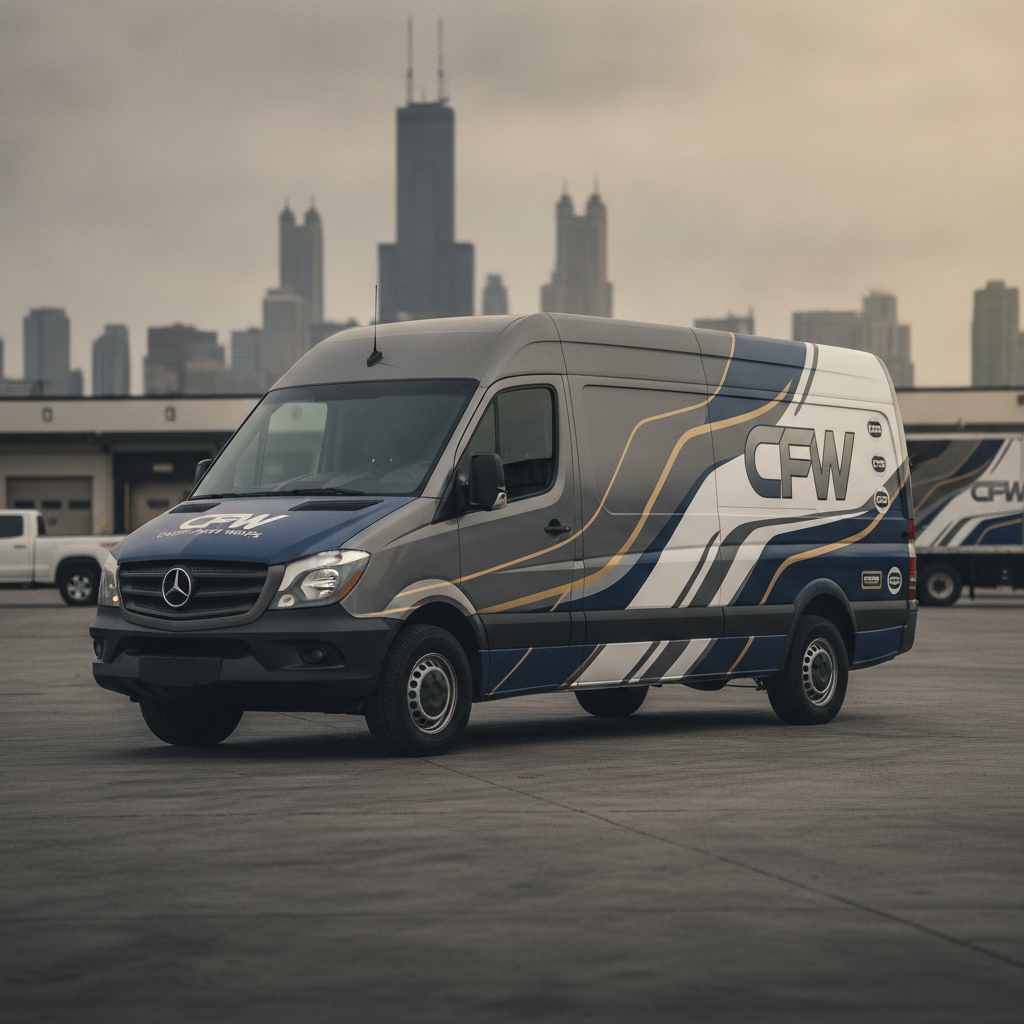
Sprinter and High-Roof Vans (Mercedes Sprinter, Ford Transit HR, Ram ProMaster HR)
High-roof extended-wheelbase Sprinters add 30 to 60 square feet over a standard cargo van, depending on body length. Expect pricing to run $4,800 to $5,800 for a full wrap at single-unit rate, varying by roof inclusion and body length. The extra height on a 170-inch HR Sprinter means a two-person install is required for roof work. Single-installer jobs on tall vans produce more stretch marks and alignment errors near the roofline.
Pros: The tall sides create billboard-scale visibility. HVAC and plumbing fleets running Sprinters in the North Shore suburbs get seen in driveways, not just on highways. High visibility in parking lots.
Cons: The Sprinter's ribbed cargo body panels on certain model years require extra heat and time during installation. Roof panels on a 170-inch HR are large and unforgiving if the installer misaligns the material during lay-down. This is where our 3M Knifeless Tape cutting system earns its keep: clean trim lines without blade contact on the paint.
Box Trucks (10-foot to 26-foot straight trucks)
Box trucks are the highest-surface-area class in a typical mixed fleet. A 16-foot box truck runs 300 to 380 square feet. A 26-foot box runs 500 to 600 square feet. Partial wraps are more common here because full coverage on a 26-footer pushes single-unit cost above many fleet managers' per-unit cap.
Pricing bands by box size: 10 to 14 foot, $3,800 to $5,200 full; 16 to 20 foot, $5,500 to $7,000 full; 22 to 26 foot, $7,000 to $9,500 full. Corrugated aluminum box bodies add a 15 to 20 percent labor premium. Cast vinyl is non-negotiable here. Calendered vinyl will lift at every corrugation ridge within 12 to 18 months, especially after a Chicago winter.
Pros: Massive impression yield per vehicle. A branded 26-foot box truck parked on Pulaski or Cicero Avenue is a stationary billboard. On I-290 westbound, it dominates adjacent traffic lanes.
Cons: Highest cost per unit. Longest install time, typically two to three days per vehicle at full coverage. Fleet discount structure matters most at this class. Getting 25-plus box trucks on a single contract at our 15 percent tier saves real money at this price point.
Pickup Trucks (half-ton and three-quarter-ton, single and crew cab)
Pickups are the most common vehicle in residential service fleets, HVAC, landscaping, and construction. A crew-cab pickup runs 120 to 160 square feet for a full wrap. Decal packages start around $1,200 to $1,800. Partial wraps land in the $2,200 to $3,200 range. Full wraps on a crew-cab run $3,200 to $4,000.
Pros: Low entry cost. Fast install, usually one day. Easy to template because body lines are well-documented across F-150, Silverado, and Ram 1500 platforms. Good for neighborhood-level brand building in areas like Bridgeport, Beverly, or Edison Park.
Cons: Low surface area means limited design space, especially on short-bed configurations. The bed interior and tailgate face down or rearward, reducing impression count. Pickup wraps earn the fewest impressions per vehicle in a mixed fleet, though their cost is proportionally lower.
Trailers (enclosed cargo, flatbed, refrigerated, semi-trailers)
Trailers are the highest-impression, highest-cost class. A 48-foot enclosed trailer runs 800 to 1,000 square feet. A 53-footer exceeds 1,000 square feet. Single-unit full wrap pricing ranges from $7,500 for a 28-foot pup trailer to $14,000-plus for a 53-foot refrigerated unit with riveted aluminum panels.
Pros: Nothing in a mixed fleet generates more impressions per vehicle. A wrapped 53-foot trailer moving on I-90/94 through the West Loop at rush hour is visible to an entire highway grid. Parked at a distribution yard, it functions as a permanent sign.
Cons: Rivet-heavy panels require channel filling or rivet-head work before vinyl goes down. Refrigerated units have insulation panels with irregular seams. Material cost is significant at this scale. Trailer wraps demand experienced large-format installers, not general-purpose shops.
Which Vehicle Class Earns the Most Impressions Per Dollar?
In a mixed fleet, cargo vans at full wrap coverage return the best impressions-per-dollar ratio across the entire class lineup. Here is the logic: a cargo van full wrap at $4,200 covers 200-plus square feet of eye-level surface, installs in one day, and operates on urban routes in high-density corridors like the Chicago CBD, Logan Square, and the North Side neighborhoods where pedestrian and vehicle traffic is dense. Box trucks yield more raw impressions per vehicle but cost two to three times more per unit. Trailers yield more total impressions but only for fleets that run highway routes consistently. Pickups cost less but carry a fraction of the surface area.
The practical recommendation for a mixed fleet: prioritize full wraps on cargo vans first, then scale box truck coverage as budget allows, then add trailer wraps for highway-heavy routes. Pickups can run a quality decal package without hurting the overall fleet impression average.
Chicago-Specific Factors That Affect Every Class
Chicago winters are not a generic cold-weather risk. The freeze-thaw cycle from November through March tests vinyl edges on every vehicle class. Road salt on the Dan Ryan and I-88 accelerates edge lift if installation corners are not properly sealed. Our climate-controlled install bay at 4711 N Lamon Ave in Portage Park keeps material and vehicle surface temperatures stable during installation, which directly affects adhesion quality in cold-weather jobs.
The 8-day production lifecycle we run, from intake to delivery, accounts for a 24-hour acclimatization period for both vehicle and material before installation begins. Shops that skip acclimatization in winter produce wraps that fail at the seams before spring. We also offer free pickup and delivery across Chicagoland, which matters for fleet managers running yards in Cicero, Elk Grove Village, or the South Side who cannot spare a driver to shuttle vehicles to a shop.
In 25 years and across 19,400-plus wrapped vehicles, we have recorded zero verified paint-damage claims. That is not a marketing statement. It is the operational result of using cast vinyl exclusively and cutting with Knifeless Tape rather than blade contact on painted surfaces.
Fleet Discount Structure: Where the Math Gets Serious
Using the cargo van full wrap at $4,200 as the baseline unit cost, here is what the discount tiers produce on a same-class fleet order:
- 2 to 4 units (3% off): $4,074 per unit
- 5 to 9 units (7% off): $3,906 per unit
- 10 to 24 units (11% off): $3,738 per unit
- 25-plus units (15% off): $3,570 per unit
On a 25-van fleet, the 15 percent tier saves $15,750 versus single-unit pricing. That saving covers the cost of wrapping three to four additional vans at the discounted rate. Fleets that bracket across two tiers should consolidate orders onto a single contract to capture the higher discount level. Splitting a 10-van order into two 5-van orders costs an extra 4 percentage points per unit.
People Also Ask
How much does it cost to wrap a cargo van versus a box truck?
A full cargo van wrap at Chicago Fleet Wraps runs $4,200 at single-unit rate, covering approximately 200 to 240 square feet of exterior surface. A full wrap on a 16 to 20-foot box truck runs $5,500 to $7,000, and a 22 to 26-foot box truck runs $7,000 to $9,500, reflecting both larger surface area and the labor premium for corrugated aluminum panels. Fleet discounts of 3 to 15 percent apply to both classes on single-contract orders of 2 or more units.
What is the difference between a full wrap, partial wrap, and decal package on fleet vehicles?
A full wrap covers all painted exterior panels with cast vinyl, giving maximum brand coverage and paint protection. A partial wrap covers 50 to 75 percent of the vehicle, typically the cargo sides and rear, and costs 30 to 50 percent less than a full wrap depending on class. A decal package applies individual cut graphics and lettering to the existing paint surface and is the lowest-cost option, typically used on pickups or light-duty service vehicles where route density does not justify higher material investment. Full wraps outperform both alternatives in impressions per square foot of vehicle surface.
Which fleet vehicle class gets the most advertising impressions per dollar spent on a wrap?
Across a mixed fleet, cargo vans at full wrap coverage return the best impressions-per-dollar ratio. Their $4,200 full wrap price point is lower than box trucks or trailers, but their 200-plus square feet of eye-level panel surface operates in dense urban corridors, highways, and neighborhood streets simultaneously. Box trucks and trailers generate more raw impressions per vehicle but at two to four times the cost per unit. Pickups generate the fewest impressions relative to their surface area. For most mixed fleets, wrapping cargo vans first and scaling to larger classes second produces the most efficient spend allocation.
Materials: Why Cast Vinyl Is Not Optional on Commercial Fleet Work
Every vehicle class in this guide gets the same material specification: Avery Dennison MPI 1105 Supercast or 3M IJ180-CV3 or 3M IJ280, all with UV overlaminate. Cast vinyl is manufactured by casting liquid vinyl onto a casting sheet, which produces a dimensionally stable film that conforms to compound curves, rivets, and corrugated panels without memory distortion. Calendered vinyl is extruded under pressure and retains internal stress. On a flat pickup hood it may perform adequately for two years. On a corrugated trailer panel or a ribbed Sprinter body, it fails predictably within 18 months. We do not install calendered vinyl. That policy is not negotiable.
Our 2-year workmanship warranty covers installation defects. The vinyl manufacturers' warranties cover material performance for 5 to 7 years under normal operating conditions. Chicago winters are not normal operating conditions for vinyl installed below 50 degrees Fahrenheit, which is why our climate-controlled bay and acclimatization protocol exist. Shops without temperature control cannot make the same warranty offer credibly.
How to Start: Getting a Quote Across Multiple Vehicle Classes
Chicago Fleet Wraps delivers a 2-hour itemized quote for any fleet configuration. Bring vehicle year, make, model, and body length for each class in your fleet. Bring your logo files in vector format if you have them. If you do not, we template from scratch. We handle free pickup and delivery across Chicagoland, so your drivers stay on route.
Call (312) 597-1286 or visit us at 4711 N Lamon Ave #7, Chicago IL 60630 in Portage Park. Reference this guide when you call and tell us your vehicle mix. We will build a per-class cost sheet with applicable fleet discount tiers before you commit to anything.
Ready for a quote? See Box Truck Wraps Chicago or get an itemized quote in 2 hours.
Frequently Asked Questions
How much does it cost to wrap a cargo van versus a box truck?
A full cargo van wrap at Chicago Fleet Wraps runs $4,200 at single-unit rate, covering approximately 200 to 240 square feet. A full wrap on a 16 to 20-foot box truck runs $5,500 to $7,000, and a 22 to 26-foot box truck runs $7,000 to $9,500. Fleet discounts of 3 to 15 percent apply to both classes on single-contract orders of 2 or more units.
What is the difference between a full wrap, partial wrap, and decal package on fleet vehicles?
A full wrap covers all painted exterior panels with cast vinyl for maximum brand coverage and paint protection. A partial wrap covers 50 to 75 percent of the vehicle and costs 30 to 50 percent less than a full wrap. A decal package applies individual cut graphics to the existing paint and is the lowest-cost option, best suited for pickups or light-duty vehicles on low-traffic routes.
Which fleet vehicle class gets the most advertising impressions per dollar spent on a wrap?
Cargo vans at full wrap coverage return the best impressions-per-dollar ratio in a mixed fleet. Their $4,200 full wrap price is lower than box trucks or trailers, but 200-plus square feet of eye-level panel surface operates across highways, urban corridors, and neighborhood streets simultaneously. Box trucks and trailers generate more raw impressions per vehicle but at two to four times the per-unit cost.